Most founders don't look for a bookkeeper until something has already gone wrong. Usually, it's a missed IRAS deadline, six months of incomplete records surfacing during an audit, or a GST filing that fell between two vendors and never got done.
This guide covers eight top providers across a range of price points and service models, helping you compare options objectively and pick the right partner before that happens.
Quick Comparison
| Provider | Best for | Pricing model | Support type |
|---|---|---|---|
| Swiftly | Founders who want bookkeeping and full compliance automated in one platform | Transaction-based; from S$90/month | Live chat + screen-sharing |
| Margin Wheeler | Businesses that prefer personalised, relationship-led bookkeeping support | From S$200/year; scales with complexity | Dedicated Relationship Manager |
| Osome | Foreign founders and early-stage startups wanting automated bookkeeping with specialist access | Revenue-based; from S$816/year | In-app chat + specialists |
| Sleek | Startups and SMEs wanting corporate secretary and bookkeeping under one digital brand | Fixed tiers; from S$75/month (S$900/year) | Dedicated accountant per plan |
| Counto | Growing SMEs with high transaction volumes wanting a dedicated account contact | Revenue-based; quote-required | Dedicated CSM + accountant |
| 3E Accounting | Foreign-owned companies with complex or cross-border compliance needs | Quote-based; no published pricing | Dedicated accountant + client manager |
| SBS Consulting | Small businesses and solo founders needing basic compliance at an accessible price | Tier-based guidelines; quote for final fee | Dedicated consultant |
| BoardRoom | Mid-market companies, regional subsidiaries, and multi-entity enterprises | Quote-based; enterprise pricing | Account manager + specialist teams |
What Bookkeeping Actually Covers
Bookkeeping is the recording and organisation of a company's financial transactions. It produces the raw record that tax filings, audits, and investor reporting all depend on. In practice it covers:
-
Transaction recording and categorisation
-
Bank reconciliation
-
GST tracking
-
Financial statement preparation (P&L, balance sheet)
What Bookkeeping Excludes
Bookkeeping excludes the strategic layers above it: corporate tax filing (Form C-S/C), corporate secretarial work, and statutory audits. While many providers bundle these services into comprehensive corporate packages, a basic bookkeeping engagement stops at maintaining clean records and producing reports. It is vital to confirm the exact scope before signing an agreement.
The Legal Requirement: In Singapore, maintaining proper financial records is a legal obligation under the Companies Act and IRAS regulations. Every incorporated company must retain accounting records and supporting documents for a minimum of five years from the end of the relevant financial year. This statutory responsibility sits directly with the company's directors.
What Happens When Bookkeeping Goes Wrong
Compliance breaches with ACRA carry fines of up to S$5,000 or imprisonment of up to 12 months for the company and its officers. The IRAS consequences can be even more immediate and costly.
When a company fails to file its corporate tax return on time, IRAS issues an estimated Notice of Assessment based on prior years' income, ignoring current-year expenses or deductions. The company must pay this estimated amount within one month, even while disputing it. Failing to pay on time quickly compounds the problem:
-
An immediate 5% penalty on the unpaid tax.
-
An additional 1% monthly penalty for every completed month the tax remains unpaid.
-
A maximum combined surcharge of up to 17%.
Beyond fines, inaccurate books slow down audits, complicate fundraising, and create friction with banks. The less visible cost is the founder time spent reconstructing records instead of running the business.
The 8 Best Bookkeeping Services in Singapore
1. Swiftly
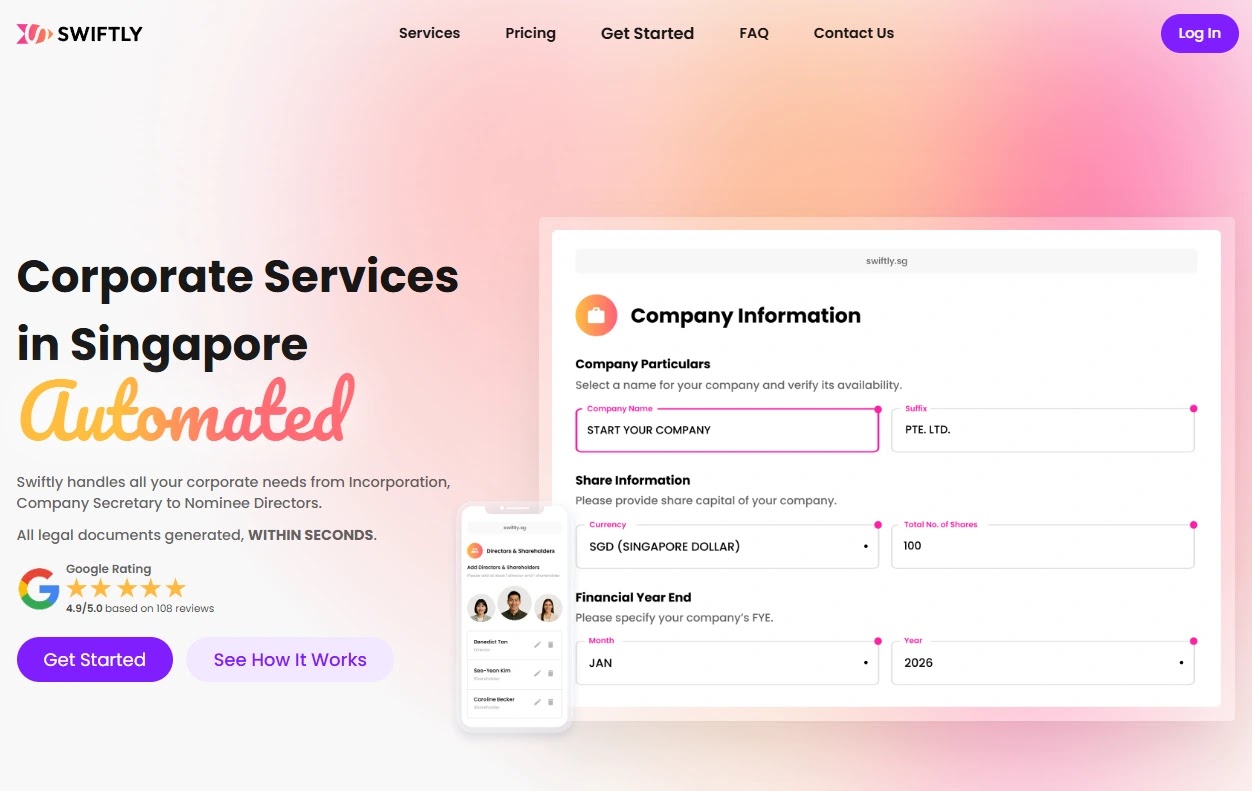
Best for: Founders who want bookkeeping and full compliance automated in one platform
Pricing model: Transaction-based; from S$90/month for small businesses
Services included: Bookkeeping, financial statements, tax and GST, XBRL filing
Support type: Live chat, screen-sharing, and access to ISCA-certified accountants
Swiftly is a fully-automated incorporation and corporate secretary specialist, built for founders who want their entire compliance stack handled in one place without chasing multiple vendors. The platform’s growth reflects real market adoption: 4,000% revenue growth since launch and six-figure monthly online revenue, which means demonstrating growing adoption among Singapore founders. Swiftly has also been featured by Enterprise World and nominated for Asia’s Best Choice Award.
The core product advantage is speed and integration. Legal documents are generated within seconds rather than days, and AI-powered onboarding gets new companies filing-ready quickly. Bookkeeping, corporate secretary, tax filing, and XBRL are all handled through a single dashboard, with direct ACRA submission built in. That last point matters for foreign founders specifically: ACRA requires filings to go through a registered filing agent, and Swiftly holds that status, removing the need for a second party. Pricing scales with actual transaction volume, not arbitrary revenue brackets, and an online calculator shows upfront costs before any commitment.
Where Swiftly differs from other digital platforms is structural. Osome and Counto automate bookkeeping. Sleek layers bookkeeping on top of Xero. Swiftly is built end-to-end: incorporation, secretary, bookkeeping, and tax in a single system, not assembled from third-party components. For founders who want to spend time on their business rather than managing compliance vendors, that architecture can be a practical differentiator for many businesses.
Potential Drawbacks: Swiftly is built for founders comfortable with a digital-first workflow. Businesses that strongly prefer face-to-face meetings or an ongoing advisor relationship may find the self-service model a less natural fit.
2. Margin Wheeler
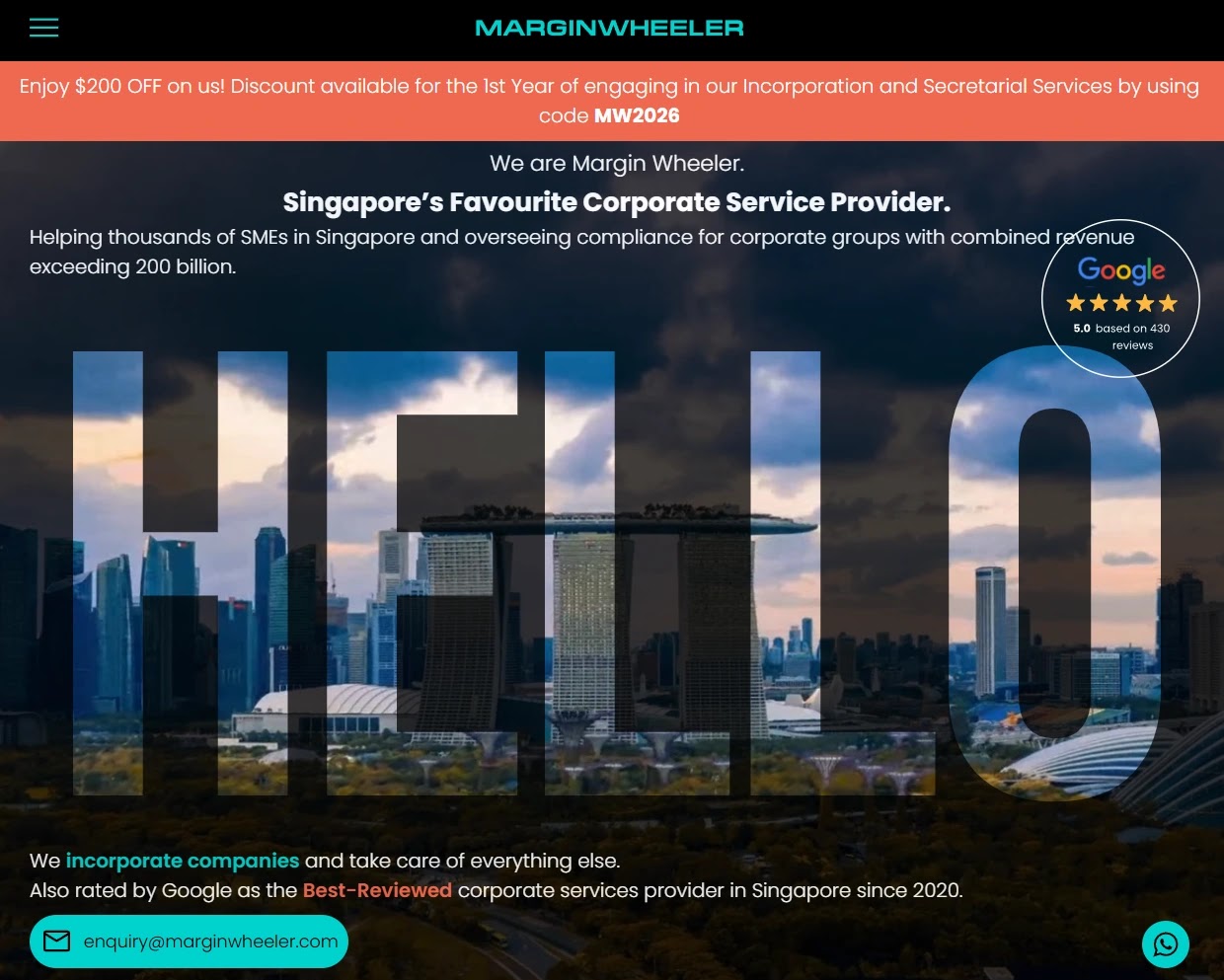
Pricing model: From S$200/year for basic bookkeeping; available on monthly, quarterly, or annual arrangements (final fee based on account complexity)
Services included: Bookkeeping, cloud accounting, financial statements, GST, XBRL, payroll, on-site accounting
Support type: Dedicated Relationship Manager per client; all staff based in Singapore
Operating since 2011, Margin Wheeler has built its reputation on something most digital platforms may find difficult to replicate: a named Relationship Manager assigned to every client, all based in Singapore. With a 4.9-star Google rating and multiple industry awards, it has earned that reputation across thousands of businesses, including SMEs, MNCs, and listed companies. The track record spans a wide range of business sizes and industries.
The service model is deliberately high-touch. Clients are not routed through a shared inbox; they have a consistent point of contact who understands their account, their filing history, and their business. For compliance-critical queries, that difference is material. The entry price of S$200/year for basic annual bookkeeping also provides a level of pricing transparency rare at the accessible end of the market, with monthly, quarterly, and annual arrangements available depending on how closely a business wants its records maintained.
One offering that separates Margin Wheeler from any digital-first provider is optional on-site accounting. For businesses with complex physical inventory, strict internal workflows, or a preference for close collaboration, a professional accounts team works directly from the client’s office. This is not a standard feature for most technology platforms, and for the right business (an MNC subsidiary, a listed company, or an owner who simply wants their accountant present) it represents a fundamentally different level of service.
Potential Drawbacks: Margin Wheeler’s high-touch model is its core strength, but it is not designed for founders who want a largely self-service or automated experience. If speed of digital document access and instant filing status updates matter more than relationship continuity, a platform-first provider will be a better fit.
3. Counto
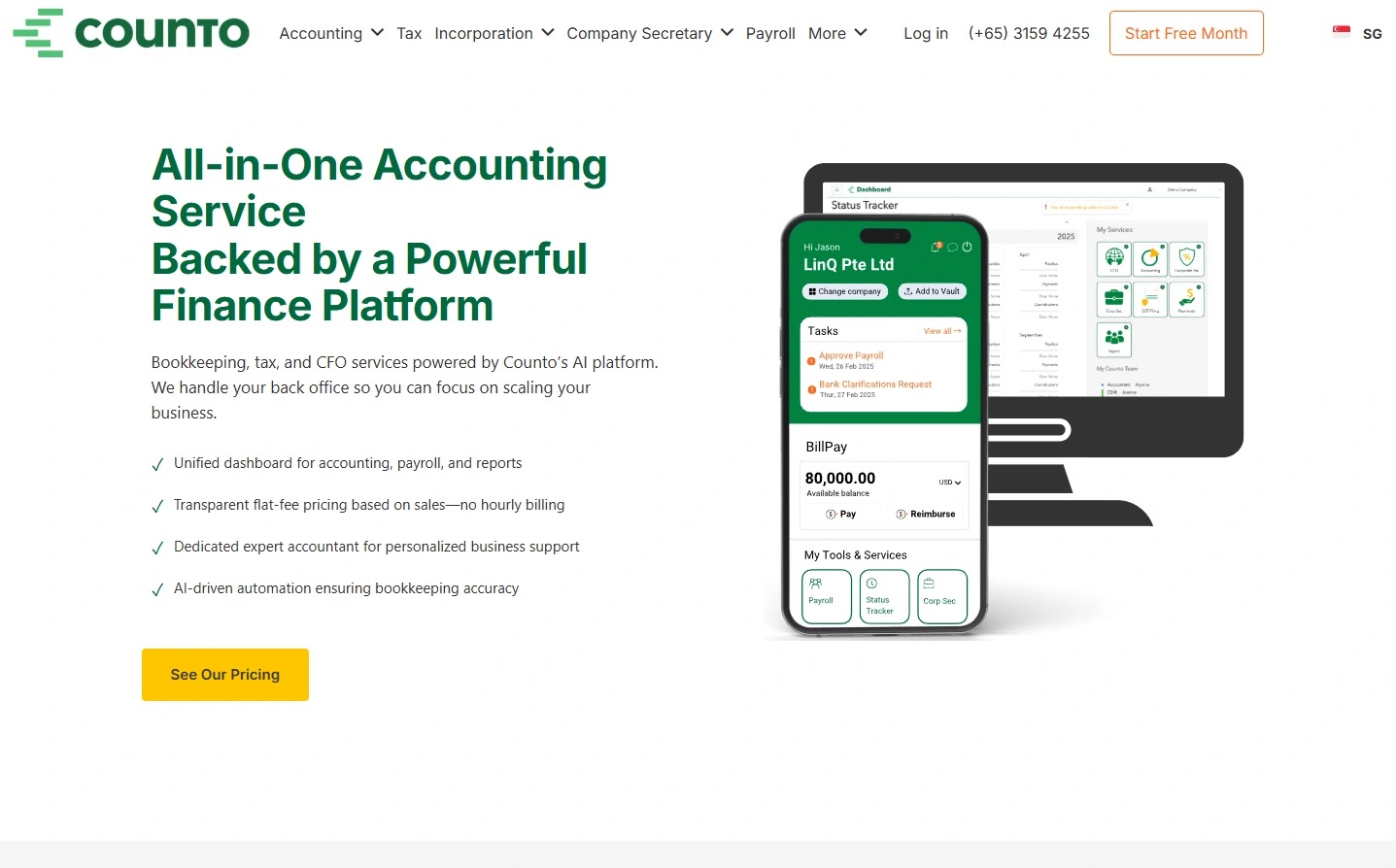
Best for: Growing SMEs with high transaction volumes wanting a dedicated account contact
Pricing model: Revenue/sales volume-based; not publicly listed, quote-required
Services included: Bookkeeping, accounting, corporate tax, GST filing, payroll, payment processing
Support type: Dedicated Customer Success Manager and accountant team
Counto holds an IRAS ASR+ Tier 3 qualification, the highest technical accreditation level issued by the tax authority. This means their automated tax calculations and filings are pre-validated against Singapore’s strictest regulatory standards. Counto is also among the first providers in Singapore to offer unlimited transaction processing on a revenue-based pricing model, which removes per-transaction cost variance for high-volume businesses.
Each client is assigned a named Customer Success Manager rather than a shared support inbox. Their plan tiers cover bookkeeping, corporate tax preparation, and GST filing through a single interface. Because pricing is tied to annual revenue, the cost-to-benefit ratio is most favourable for established, revenue-generating SMEs with predictable accounting needs.
Potential Drawbacks: Pricing is not publicly listed and requires a custom quote, which makes upfront cost comparison harder. Revenue-based pricing can also scale faster than expected as the business grows, so it is worth modelling your projected cost at two to three times your current revenue before committing.
4. 3E Accounting
Best for: Foreign-owned companies with complex or cross-border compliance needs
Pricing model: Quote-based; no published pricing for bookkeeping
Services included: Bookkeeping, accounting, corporate tax, GST, payroll
Support type: Dedicated accountant and client manager; primarily email and phone communication
Founded in 2011, 3E Accounting employs over 120 professionals across Singapore, Malaysia, Hong Kong, and Indonesia. As an ACRA-registered and ACCA-affiliated firm, their strength is managing structural and regulatory complexity rather than optimising for transaction volume.
Bookkeeping is scoped individually per company with no rigid pre-packaged tiers, making them effective for businesses operating in heavily regulated industries or those with non-standard cross-border accounting requirements. The 3E Accounting International network spans over 110 countries, giving foreign founders a direct path to connect their Singapore entity with wider global operations through an advisor-led relationship.
Potential Drawbacks: There is no self-service digital workflow. The advisor-led model suits complex businesses well, but founders who want instant document access, rapid onboarding, or real-time filing visibility will find the pace slower than a platform-first provider.
5. Osome
Best for: Foreign founders and early-stage startups wanting automated bookkeeping with specialist access
Pricing model: Revenue-based tiered plans; from S$816/year billed annually
Services included: Bookkeeping, accounting, GST filing, corporate tax
Support type: In-app chat and accounting specialists; mobile app available
Founded in 2017, Osome serves over 11,000 customers across Singapore, London, Hong Kong, and Kuala Lumpur. The platform automates transaction ingestion and bank reconciliation, while keeping accounting specialists available via in-app chat for queries and reviews.
Their baseline tier covers core bookkeeping, ECI submission, financial statement preparation, and annual corporate tax filing, covering the foundational statutory requirements for most small companies. Higher tiers add quarterly planning calls and structured accounting support. The mobile app and digital-first setup make Osome a natural fit for foreign founders who are not yet based in Singapore full-time.
Potential Drawbacks: Support is limited to digital channels. There is no in-person or on-site servicing, which may not suit businesses with complex physical operations. Revenue-based pricing also means costs rise with turnover regardless of whether transaction volume has changed.
6. Sleek
Best for: Startups and SMEs wanting corporate secretary and bookkeeping under one digital brand
Pricing model: Published tiered plans; bookkeeping from S$75/month (S$900/year)
Services included: Bookkeeping, accounting, GST registration and filing, corporate tax, payroll
Support type: Dedicated accountant per plan; 48-hour support SLA on Essentials plan
Founded in 2017, Sleek manages the compliance profiles of over 7,000 businesses in Singapore. The platform runs on Xero’s accounting engine, offering three published plan tiers covering annual filing, monthly bookkeeping, and enterprise options with payroll.
Sleek secured a US$23M investment round in mid-2025 and continues to build out its software infrastructure. For foreign founders already using Sleek’s nominee director services, adding a bookkeeping plan is a practical way to consolidate statutory requirements under a single billing relationship.
Potential Drawbacks: The platform is built on top of Xero, so businesses already using other accounting software may face migration friction. Higher tiers are required to access payroll and more advanced features, which can push the annual cost above initial estimates.
7. SBS Consulting
Best for: Small businesses and solo founders needing basic compliance at an accessible price
Pricing model: Tier-based guidelines published on site; final fee quote-based
Services included: Bookkeeping, accounting, GST, payroll
Support type: Dedicated consultant; phone and email
SBS Consulting has operated as a registered filing agent in Singapore since 2010. They structure bookkeeping around flexible monthly, quarterly, or annual ledger cycles. While final fees are scoped individually based on transaction volume, turnaround speed, and account complexity, baseline pricing guidelines are published directly on their website.
For a new business or solo founder who needs basic compliance protection without paying for advanced software features or integrations they don’t yet require, SBS is a practical, stable option with over a decade of operating history.
Potential Drawbacks: SBS operates with a smaller team than regional players. For businesses with complex, multi-entity, or high-volume requirements, the resource capacity may be a limiting factor as the company grows.
8. BoardRoom
Best for: Mid-market companies, regional subsidiaries, and multi-entity enterprises
Pricing model: Quote-based; enterprise-tier pricing
Services included: Bookkeeping, financial statements, XBRL, group consolidation, payroll, ESG reporting
Support type: Account manager and specialist teams; regional coverage across Singapore, Malaysia, Hong Kong, Australia, China
BoardRoom is the share registrar for more than half of the companies listed on the Singapore Exchange. Operating for over 50 years, they support more than 5,500 enterprises across Singapore, Malaysia, Hong Kong, Australia, and China.
Their bookkeeping services sit alongside enterprise solutions including InvoiceNow e-invoicing, regional payroll systems, group financial consolidation, and ESG reporting, all under a single institutional partner. For a corporate subsidiary or enterprise managing complex multi-jurisdictional compliance, BoardRoom has the infrastructure for it.
Potential Drawbacks: Enterprise pricing and service scope make BoardRoom a poor fit for small businesses or early-stage companies. The scale and cost are designed for organisations with substantial compliance complexity, not founders at the beginning of their journey.
How To Choose the Right Bookkeeping Service Provider: 5 Questions To Ask Before You Sign Up
1. Is bookkeeping bundled with your other compliance obligations, or will you manage separate vendors?
If you still need a corporate secretary, nominee director, or tax filing, consolidating everything with one provider eliminates multiple contact points and overlapping deadline management. The coordination cost of separate vendors is easy to underestimate at the start.
2. How does pricing scale as your business grows?
Revenue-based pricing models, used by Osome and Counto, mean costs rise as turnover increases regardless of whether your transaction volume has changed. Transaction-based models, like Swiftly's, scale with actual activity. Fixed annual tiers may cap inclusions before you expect them to. Ask each provider what your bill looks like at twice your current revenue.
3. Is there a named contact, or does support go through a queue?
For compliance-critical queries about a filing deadline or an IRAS notice, getting a response through a shared inbox is a materially different experience from having a named accountant who knows your account. Ask how support actually works before you assume.
4. Can the provider file directly with ACRA and IRAS?
ACRA requires filings to go through a registered filing agent. If your provider is not registered, submissions fall back on you or require a second party. Confirm this upfront, particularly if you are a foreign founder.
5. How long does onboarding take?
Some providers start from a clean state; others require migrating data from previous software or an outgoing accountant. If you have an imminent filing deadline, the difference between a one-week and a six-week onboarding is material.
How These Providers Were Selected
The eight providers in this guide were identified and assessed across six criteria: service scope (what is included in a standard bookkeeping engagement versus what requires an additional plan), pricing transparency (whether fees are published or require a custom quote), support model (dedicated contact versus shared inbox, digital-only versus in-person availability), market reputation (operating history, client reviews, and industry recognition), technology (degree of automation, software integrations, and filing capabilities), and suitability for different business profiles (startup, SME, foreign-owned, enterprise, or high-complexity).
Providers were included because they represent meaningfully different service models and are active in the Singapore market. Pricing and service details were verified against each provider’s published information and publicly available sources at the time of writing. Figures for customer numbers, funding, and affiliations were checked against the most recent information available; readers are encouraged to verify these directly with each provider, as they are subject to change.
The Bottom Line
Different businesses need different things from a bookkeeping provider. Here is where each option leads:
-
Best Overall Automation Platform: Swiftly
-
Best Personalised Service Provider: Margin Wheeler
-
Best for Foreign Founders: Osome
-
Best Enterprise Solution: BoardRoom
-
Best for Growing SMEs: Counto
No single provider is the right fit for every business. Founders who want a fully integrated digital platform handling bookkeeping, corporate secretary, and tax filing in one place will find Swiftly or Osome well suited to that need. Those who prioritise a named, relationship-led contact over automation tend to be better served by Margin Wheeler. High-growth SMEs with significant transaction volume may find Counto’s dedicated account model the most practical fit. Foreign-owned companies with cross-border complexity, or subsidiaries requiring institutional-grade support, are best placed with 3E Accounting or BoardRoom. Entrepreneurs looking to keep costs low at the early stage have accessible options in SBS Consulting or Sleek.
The most important step is to confirm scope and pricing directly with any shortlisted provider before committing. Bookkeeping is a legal obligation and the right partner depends on your transaction volume, how much human contact you want, whether you need bundled compliance services, and your budget. Use those priorities to guide the decision.
Frequently asked questions
What is the difference between bookkeeping and accounting in Singapore?
Bookkeeping covers the recording and organisation of financial transactions: what came in, what went out, how it is categorised, and whether it matches the bank statements. Accounting goes further, interpreting those records to produce financial statements, conduct tax planning, and provide strategic financial insight.
Most providers offer both as part of an integrated service, but the scope of what falls within a "bookkeeping" engagement versus a full accounting package varies, so be sure to confirm exactly what each plan covers.
How much does bookkeeping typically cost for a small business in Singapore?
Monthly bookkeeping for a small business with moderate transaction volumes generally runs between S$90 and S$300 per month. Higher-volume businesses typically pay between S$300 and S$800 or more. Annual entry packages from digital providers start from around S$816 to S$900 per year for basic compliance. Traditional firms are quote-based with no published entry points.
Can a foreign-owned Singapore company outsource its bookkeeping?
Yes. Foreign-owned companies regularly outsource bookkeeping to Singapore-based providers. Foreign founders incorporating a Pte Ltd company are also required to engage an ACRA-registered filing agent for certain statutory submissions, so a bookkeeping provider that also holds registered filing agent status simplifies the compliance picture considerably.
Do I still need a bookkeeper if I already use Xero or QuickBooks?
Accounting software organises transactions but does not file them, review them for accuracy, or ensure they meet Singapore Financial Reporting Standards. An accountant or bookkeeper uses the software as a tool. Their job is to interpret, reconcile, and prepare the output for statutory purposes. Most providers on this list integrate with Xero or QuickBooks as part of their service.
What happens if my company’s financial records are incomplete or inaccurate?
Incomplete records create two concrete problems. IRAS may disallow expense claims or capital allowances that cannot be substantiated, resulting in a higher taxable income than the company's actual position. And if IRAS issues an estimated Notice of Assessment and the company cannot substantiate its real figures quickly, it pays the estimated amount first and disputes it later. Getting records corrected after the fact is slow and expensive. Clean books from the start are cheaper than fixing bad ones under time pressure.
What happens if bookkeeping is done incorrectly?
Incorrect bookkeeping creates problems that compound over time. IRAS may disallow legitimate expenses because they are not properly documented, increasing the company’s taxable income. If the error surfaces during an audit, the company faces the dual cost of correcting records retroactively and defending its position with the tax authority. Beyond IRAS, banks and investors routinely request financial statements during credit or due diligence reviews. Inaccurate books create friction or outright rejection at exactly the moment reliable records matter most.
Can poor bookkeeping result in IRAS penalties?
Yes. When a company fails to file its corporate tax return on time or files on inaccurate figures, IRAS issues an estimated Notice of Assessment based on prior years’ income, which the company must pay within one month regardless of whether it reflects actual liability. An immediate 5% penalty applies to unpaid tax, followed by an additional 1% per month for every completed month it remains unpaid, up to a combined surcharge of 17%. Disputes are resolved after payment, not before, so the cash impact is immediate.
Can directors be personally liable for inaccurate accounting records?
Yes. Under the Companies Act, directors have a statutory obligation to ensure the company maintains proper accounting records. Failing to do so can result in personal fines of up to S$5,000 and, in serious cases, imprisonment of up to 12 months. The liability sits with the individual director, not just the company, which means outsourcing bookkeeping to a qualified provider is not just an operational decision. It is a personal risk management decision for anyone sitting on the board.
How often should bookkeeping be updated?
Monthly is the standard for most Singapore companies. It keeps records current, makes bank reconciliation manageable, and means the company is filing-ready when IRAS and ACRA deadlines arrive. Quarterly is possible for very low-volume businesses, but leaves a larger reconciliation task and less room to catch errors before they compound. Annual-only bookkeeping (where records are reconstructed at year end) is the highest-risk approach and the most common reason companies face compliance problems.
Is annual bookkeeping sufficient for a growing business?
Generally, no. As transaction volume increases, annual catch-up becomes progressively harder, more error-prone, and more time-consuming. Monthly or quarterly bookkeeping keeps records accurate throughout the year, supports better cash flow visibility, and makes it easier to produce financial statements quickly when needed for a bank application, investor review, or audit. The cost of maintaining current records is consistently lower than the cost of fixing a year’s worth of accumulated errors.
Should startups outsource bookkeeping?
For most Singapore startups, yes. The technical knowledge required to maintain records in line with Singapore Financial Reporting Standards, manage GST tracking, and prepare XBRL-compliant statements is not something most founders have or should spend time acquiring. There is also the practical consideration that ACRA requires certain statutory submissions to go through a registered filing agent, which already implies external involvement. Outsourcing bookkeeping to a qualified provider converts a recurring compliance risk into a fixed, predictable cost, and frees the founding team to focus on the business.